Registration Coming Soon
August 27th, 2008Registration for the 2008-2009 Austin Distance Challenge will be up on September 1st.
Registration for the 2008-2009 Austin Distance Challenge will be up on September 1st.
Over 150 runners celebrated the winter running season with the Austin Runners Club (ARC) last week at Hoovers Online offices. Runners enjoyed food, catered by Curra’s, camaraderie, Distance Challenge Age Group Awards, and Dick Beardsley.

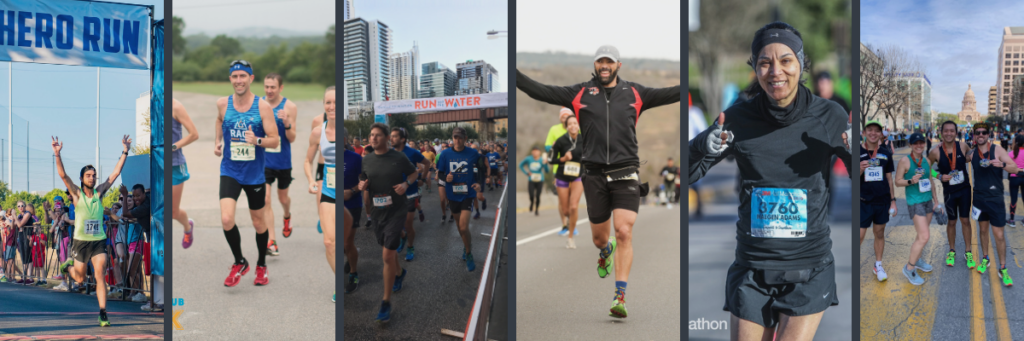
Pictured above are some of the 2007-2008 RunTex Distance Challenge Age Group winners who attended the ARC Dinner.
Membership does have it’s priveleges as dinner was provided free for all ARC dues paying members. Not currently a member? Click here to join today!
What the AT&T Austin Marathon lacked in world-class times, it more than made up for in world-class drama. The 17th running of Austin’s marathon had the second slowest winning time since the race’s inception in 1992, but featured a thrilling three-man duel on Sunday morning which wasn’t decided until the final few hundred meters down Congress Avenue.
And get this: The winner was American. That’s pretty rare these days in any marathon. An American hadn’t won here in 14 years and it looked like that might never happen again.
But Jacob Frey, a 26-year-old, second year law student from Villanova University in Philadelphia, emerged from a three-man group which had been chasing the leader Wesley Ochoro (and race favorite) for nearly 15 miles. Frey, Mikhail Sayenko from Seattle and Joseph Mutinda caught an obviously spent Ochoro on 41st Ave (23 ½ miles). From there, the three surged back and forth on each other until Frey opened a narrow gap going up the three-hill torture chamber of San Jacinto at 25 ½ miles and pulled ever so slightly away on the turn on 11th Avenue to lead the entire 6000-marathoner procession down Congress Avenue to the finish between 7th and 8th streets.
That Frey’s winning time of 2:20:38 was his slowest marathon hardly mattered. What mattered was that AT&T Austin became the first marathon he has ever won out of the six he has run.
“This race wasn’t about time. It was all about winning,” said Frey who ran 2:17:37 in Austin two years ago—the last year the north-to-south, point-to-point course was used. “I knew it wasn’t going to be a fast race so I could have cared less about time. I just wanted to win it very badly.”
So did Sayenko. The former University of Washington runner, just 23, was only running his third marathon and figured if he could stick with Frey as long as possible, he’d get pulled to a good time. He didn’t get a great time either—2:20:42—but was absolutely thrilled to finish second.
“Finishing second, is just like a win to me,” said Sayenko, who finished 29th in the Olympic Trials Marathon in November. “Our bib numbers were one and two and that’s how we finished. Sure, I would have liked to win but this was the best marathon of my life.”
Joseph Mutinda of Kenya finished just behind Sayenko for third in 2:20:43 with Ruben Gomez of Mexico fourth in 2:23:57. Early front runner Wesley Ochoro gamely held on for fifth in 2:24:06.
Ochoro had set the early pace for more than 13 miles on a perfect day for marathoning. Temperatures were in the mid-40s, there wasn’t a cloud in the sky and the breezes were barely noticeable for much of the race. Fireworks in the early-morning darkness and a booming cannon set the field of 13,000 (including half marathoners) off on the long climb south on Congress Avenue.
Three-time winner Andrzej Kryscin led the marathoners for the first 10-K (reached in 32:40), but soon after, on Lake Austin Boulevard, the pack gobbled him up. A couple of miles later, on the long, agonizing climb up the Exposition hills, around 10 miles (split of 53:27), Ochoro began to assert himself.
Ochoro was running only his second marathon. His first came just five weeks ago at the P.F. Chang’s Rock ‘n’ Roll Arizona where he ran 2:19. But in between Arizona and AT&T, Ochoro finished fifth in the 3M Half in 1:03 and, as it turned out, was running on borrowed time (and dead legs).
But still Ochoro hammered away on the tough, early hills and opened up a two-minute gap on a chase pack that couldn’t even be seen at halfway (reached in 1:09:45). Five miles later, he went from running 5:20 miles to 5:30 to 5:37 to a virtual jog. His 22nd mile provide decisive as he bonked with a 5:57 mile.
The pack, headed by Frey and Sayenko, smelled blood and when Ochoro followed with a 6:08 mile between 23 and 24, it was apparent that he was fried. On 41st, on the north side of the Hancock Golf Course, the threesome pounced on the spent Kenyan and though they struggled up the San Jac hills two miles later, like everyone else, Frey proved he had a little more left to take the win on Congress in front of the Paramount.
After crossing the line and being tossed an American flag, Frey, who grew up in Virginia and ran for William and Mary, jogged slowly back toward the Capitol, waving his arms to the huge, boisterous crowd that lined both sides of Congress. But Frey’s jubilance was short-lived. A few steps into his victory jog, Frey’s stomach recoiled from the hard, desperate strain of the last hour and he deposited its contents on the street—fittingly—right on the finish line.
“The key for me today was patience,” said Frey who finished 22nd in the Olympic Trials in New York in 2:18. “I didn’t think the guy who was leading could hold it all by himself out there. I knew it was going to be a tactical race because we weren’t moving fast. All I cared about was getting to the line first.”
That sentiment was echoed by women’s winner Lucy Hassell of Bristol, England. Hassell with modest bests of 2:38:09 in the Toronto Marathon two years ago and a half of 1:15 wasn’t considered one of the pre-race favorites in the marathon.
But she also showed great patience and restraint by running a negative split on the hilly out-and-back course. “I thought this was a fantastic race,” said the 29-year-old after winning by more than seven minutes in a glittering time of 2:36:26. “I had heard it was a bit hilly, but I loved that. There was never a dull moment out there. The support and the music really helped. Especially on those last hills {San Jac}. I heard a band just when I was struggling near the finish and it gave me a lift.”
Evidently. Finishing behind Hassell was Becki Michael, a 24-year-old from Akron, in 2:43:42 with Nicole Stevenson, a 34-year-old from Toronto third in 2:44:46. Kelly Handel was the first Austin woman in 2:54:25 (eighth place) but missed getting the Olympic Trials qualifying mark of 2:47.
In the accompanying half marathon, Austin’s Desiree Ficker was an easy winner in the women’s division with a time of 1:18:17. Ficker, who finished second last year in the marathon, was using the half as part of her preparation for the Olympic Trials Marathon in April. Bridget Montgomery was second in 1:23:17 and Jessica Durrant was third in 1:23:44. Amy Marsh of Austin, like Ficker, a professional triathlete, had a great race with a huge PR of 1:24:40 to nab fourth.
The men’s half was won by Brian Sell of Rochester Hills, Michigan in 1:04:11. Sell, who finished third in the Olympic Trials Marathon in November, led a Brooks-Hanson sweep of the first six places with Todd Snyder getting second in 1:04:58 and Mike Morgan third in 1:05:10. First Austinite was Gilbert Tuhabonye in 10th in 1:12:20. Gilbert’s cousin Bernard Manirakiza was among the leaders for the first six miles, but dropped out at eight miles due to lingering Achilles problems.
Sell, who won the Miami Half Marathon three weeks ago, was disappointed with his time and effort. “I just didn’t attack like I wanted to do today,” said the 29-year-old who is a past winner of the 3M Half. “I knew it wouldn’t be a fast time, but it is still a little slow. The weather in Michigan has been pretty tough for us and because of it, maybe I was too conservative. But it’s always great to run here and actually see the sun for a change.”
Austinites see the sun all the time—just not on Saturday—and dominated the age-group standings. Among the women, locals were led by Anna Seals, who just celebrated her 24th birthday, with a massive 20-minute PR of 3:12:43 to capture second in the 20-24s. Cindy Schlandt, 40, won the 40-45 in 3:38:18 with Marlene Hicks of Georgetown third in 3:18:54. Mary Faria, 50, won the 50-54 in 3:45:49 with Charlene Janiak second in 4:01:23. Isabel Hoverman, 62, won her age group in 4:23:56 as did Tery La Rosa, 65, in 4:53:40. Vonda Adams, 73, earned an age-group win in 5:22:03.
Austin’s men also fared well in the age group divisions. Dawit Sayfu of Gilbert’s Gazelles finished second in the highly competitive 20-24 in 2:40:54. Joshua Keena, 33, who won the ARA 30-K six weeks ago, placed third in a major PR of 2:32:37 to finish third in his age group. (Keena, a major in the Army, would have won the military division had he entered.) Michael Woo, 45, pushed all the way to a 2:50:44 to finish second in the 45-49.
And 62-year-old Gregg Evans, made a great comeback from prostate surgery just eight months earlier, to gut out an age-group win in 3:29:48.
The 17th AT&T Austin Marathon capped a sensational season of distance racing as the marathon was the finale of the RunTex Distance Challenge. What started in the warmth of early fall with IBM and the Run for the Water 10-Miler came full circle as the 13,000 runners were rewarded with picture perfect conditions for AT&T.
The AT&T course certainly isn’t easy. But a marathon—any marathon—never is.
The goodie bag that runners in the 3M Half Marathon receive is unparalleled for its useful, fun stuff. But the goodies that 3M dished out on Sunday morning were even better.
With near-perfect conditions (44 degrees at the start, a gentle breeze), a record field of 5346 witnessed one of the best days in Austin racing. PRs fell all over the fast, downhill course and the elite field contributed to a spectacular morning of racing.
The first three men finished within four seconds of each other and Moroccan Ridouane Harroufi won an amazing duel by just one second over Scottish star Andrew Lemoncello in 1:03:12 with Derese Deniboba of Ethiopia in third in 1:03:16. The winning times didn’t quite match the quality of the racing that had no fewer than 10 men battling it out until the 12th mile when Lemoncello and Harroufi busted it open.
“I wanted to run 1:01 this morning, but the early part of the race was too slow,” said the 26-year-old Harroufi who lives in Albuquerque and won the Dallas White Rock Half last month in 1:03:03. “By 10-K {reached in 31:18}, I knew it wasn’t possible to run a fast time today so I decided to just use my speed at the end.”
Lemoncello, who lives in Flagstaff, moved first as the huge pack flew down Duval. “The pace lagged, but I tried to shake things up with 5-K to go. I pushed it as hard as I could, but just didn’t have another gear to catch Harroufi.”
Nobody did. Although the winning time was nowhere near the event record of 1:01:16, the excitement of seeing as many as men duking it out overcame the sluggish time. In all 10 men, dipped under 1:05 with defending champion Alene Ruta of Ethiopia coming in eighth in 1:04:50.
Hanging onto the back of the lead pack for 10 miles was Austin’s Bernard Manirakiza who was hoping to better his PR of 1:03 which he set in this race two years ago on the traditional course which finished at House Park. Manirakiza, who is just rounding into racing form, got gapped right at the beginning and languished between 13th and 15th before pounding the second half of the course (he had the eighth fastest split) to finish in a laudable 1:04:58, good for 10th.
“I felt like I could have done a little better,” said the native of Burundi, “but I didn’t have the leg turnover. The first part of the race wasn’t fast and it should have felt easier to me, but I haven’t competed enough recently with runners like these guys.”
Even though the men put on a great show, the day clearly belonged to the women. Front and center were Jacqueline Nyetepi, a 24-year-old Kenyan who lives in Las Cruces, New Mexico and Argentinian Claudia Camargo, a 35-year-old who now lives in Danbury, Connecticut.
The two faced off right from the gun outside the Gateway Shopping Center in north Austin and went toe-to-toe all the way to the finish on Trinity, near downtown. Nyetepi, who won the Dallas White Rock Half Marathon in December November in 1:11:46, absolutely blistered the 3M course to win a drag race with Camargo and Hyvon Ngetich of Kenya.
Nyetepi waited until to Trinity to outgun Camargo in the final 600 meters to win in 1:09:32 which bettered the event record of 1:09:52, set by Sylvia Mosqueda in ’04. Camargo also broke the record as she settled for second in 1:09:42 with Ngetich two seconds back of her.
The women’s race was of such a high caliber that defending champ Kathy Butler ran 17 seconds quicker than last year and yet was a distant fifth in 1:10:55. “We went through 10-K in 33 minutes,” said Butler, “and I knew this was going to be crazy.”
Crazy fast. The top American was Deeja Youngquist of Albuquerque who placed eighth in 1:15:10. Finishing just outside the top 10 was Chris Kimbrough of Austin who still PR’ed in 1:15:38. As an example of just how deep the field was on Sunday, Kimbrough finished fifth last year in 1:15:39.
“I felt consistent out there,” said the 38-year-old Kimbrough who is training for the Olympic Trials Marathon in April. “My second half was a little slower than I wanted, but overall it was a good effort.”
Not faring quite as well as Kimbrough was Austin’s Desiree Ficker who was third last year in a PR of 1:14:10. After the race on Sunday, Ficker wasn’t making any excuses for her desultory 1:17:06, but a 22-mile run last weekend clearly played a factor. Still, Ficker put a positive spin on the morning, “I’m happy. I would have liked to run a little faster, but I’m putting a lot of miles in right now {for the Olympic Trials Marathon} and felt it.”
Masters times were particularly impressive. Heading the field was 40-year-old Nikolay Kerimov who ran 1:07, followed by 47-year-old Paul Zimmerman of Cedar Creek in a superb 1:07:16 with Ernesto Caballero third in 1:09:56.
The masters women were led, once again, by 43-year-old Albina Gallyamova in 1:16:27 with Lisa Goldsmith of Nederland, Colorado second in 1:21:18 and our own Cindy Salazar, 43, in a stunning 1:26:08 that comes right on the heels of a masters victory at the Philadelphia Half in November in 1:27:19. (What’s gotten into this gal?)
Locals fared well in several of the age groups. Lisa Preeg took the 40-44 women in 1:28:43 (the elite masters didn’t count in the standings) and Barry Trickey won the men’s 40-44 in 1:17:21 with Scott Birk second. Michael Woo paced the 45-49 men in 1:16:23.
The Wonder from Down Under, 52-year-old Keith Dowland continued to defy Father Time as he ran a brilliant 1:14:27 to easily win the 50-54s in a clocking that was 90 seconds faster than he ran last year at 3M. Denny Weiler won the 55-59 in 1:26:49 with John La Claire second.
But the most astounding time of the day had to go to 61-year-old Alberto Emiliano of Wimberly who ran 1:24:09 (6:25 pace) to hand Houston’s Ben Harvie (second in 1:26:10) a rare age-group loss.
This was the fifth race in the RunTex Distance Challenge. All that’s left in this year’s series is the big enchilada: The AT&T Austin Marathon on February 17th.
Well, it isn’t called the RunTex Distance Challenge for nothing. But the Austin Radiological Association 30-K Sunday in the Lost Creek/Barton Creek hills…er, mountains added a new dimension to the toughness of the series.
Any race is a battle against the elements, course and distance. On Sunday morning, more than 850 runners turned out in force to go one-on-one with the hardest road-race course Austin has ever seen…and the course won.
Just how hard was it? Perhaps third-place finisher Michelle Maton summed it up best when she said afterward: “The marathon {AT&T Austin Marathon on February 17th} will seem easy compared with this race.”
Indeed. In this 18.6-mile race, there was not a single easy stretch of running. If you weren’t climbing up one monstrous hill after another, you were falling off the cliff down the other side. Toss in a troublesome, blustery wind and some unseasonably warm conditions and the ARA 30-K is a race that will be talked about (and grow in legendary status) for years and years to come.
“It was just crazy running those hills,” said Patrick Darragh after finishing fourth. “I mean, those were some of the hardest hills I’ve ever run, but the final ones were just awesome.”
The ultimate character test were the last three up-and-down miles back to the start/finish line at Lost Creek and 360. Those behemoths were so steep, so unrelenting that they humbled just about everybody and forced most into walking at least part of the way.
But not Major Joshua Keena. The 33-year-old West Point grad ran every step of the course and on the brutal three-mile gut check back to the finish, he even got up on his toes and accelerated as he passed the stragglers from the accompanying 10-Miler.
Keena had taken over the lead in the third mile from early frontrunner Adam Reiser who was forced to drop out with hamstring troubles. Once Keena took over from Reiser, he extended his lead to the point where he was out of sight of everyone but Craig Ottman of Keller who struggled to keep him within range.
But Keena, who is pursuing his Ph.D. in mechanical engineering at UT, was not to be denied on Sunday. Running in his first Distance Challenge series race, Keena said after winning in 1:53:16: “I thought this was a great course. I loved it.”
Winners have a way of stuff like that in the endorphin rush of victory. But the muscular Keena, who likes every bit the military man, said he’d even run it again.
His goal was to run six-minute pace in preparation for the AT&T Austin Marathon which will be his first real 26-miler (he ran San Antonio in the 2:45 range but was injured). “I didn’t run quite as fast as I wanted this morning because the hills took a little bit more out of me than I expected.”
Him and everybody else. Other than the closing three-mile torture test, perhaps the hardest stretch was the two-mile, out-and-back section along Southwest Parkway. Compared with the rest of the course, this wasn’t the hilliest section but when a headwind kicked up, it made for some tough sledding and had everyone looking to duck behind a bigger body for protection.
“That wind just kicked my butt,” said Paul Pugh, who finished sixth in 2:01:02 and actually walked backward up a couple of the final hills.
Following Keena to the line was Ottman in 1:55:52 with Josh Lee in third in 1:56:25 and Darragh fourth in 1:56:55.
First masters man was the 45-year-old whiz kid–Michael Woo–who placed a superb seventh overall in 2:01:32. “The uphills were unbelievably hard,” said Woo, stating the obvious, “but the downhills were so steep some of them were very dangerous.” First really old guy was 52-year-old Brad Sprague in 2:18:24.
Finishing right in back of Woo was Wonder Woman herself—Desiree Ficker—who is knee deep into her training for the ’08 U.S. Olympic Marathon Trials in April. The Iron Woman’s goal was to run 6:30 pace for the 30-K, but, like everyone, she slowed in the concluding three miles, yet was still an easy winner in 2:04:41.
Check that. Nothing was “easy” about this race. “I wanted to run comfortably this morning,” said Ficker, the 31-year-old professional triathlete. “I knew it would be hard—and it was—but I thought the course was great in a masochistic kind of way. The beauty of it was I never got bored—even while running on Southwest Parkway. The scenery was constantly changing and I loved that element about it.”
Finishing a strong second to Ficker in 2:15:02 was 22-year-old Rachel Collins who ran cross-country at SMU. Collins, who looked like she was out for a jog on Lade Bird Lake, moved steadily up and then was able to get up and over the last three-mile stretch to overhaul Michelle Maton (who had a bathroom break) on the short downhill run-in to the finish.
“It was very tough,” said Collins, “so I tried to hold something back. I didn’t want to run too hard too early. I wanted to save something for the end.”
Maton, the 39-year-old mother of five, finished third in 2:15:29 but still easily leads the women’s standings in the RunTex series. She has now finished third in three of the races and fourth in the IBM lead-off race.
“This was the longest I have ever run,” said Maton, forgetting that she has run the AT&T Austin marathon once. “My legs felt like Jello out there, especially on some of the downhills. I’m just glad I finished.”
Carolyn Newman, a postgrad student at UT, finished fourth in 2:20:46 (her best finish in the series) and Jill O’Neal, who has been ill for the past three weeks, gutted out fifth.
Carl Stones, an 18-year-old punk from Round Rock, took the accompanying 10-Miler in 1:11:22 with Cody Smith of Cypress second in 1:13:54 and long-striding Tom Ruthven in third in 1:18:12. Carrie Peterson was the first woman in 1:28:33.
The future of this race will probably rest with the 10-Miler. Chances are pretty good that the race will live on at the same venue (minus Southwest Parkway), but stick with the 10-mile distance. The 30-K will stay remain in next year’s Distance Challenge Series, but look for the course to be shifted to the north, probably to Georgetown.
Next up in the RunTex Distance Challenge series is everyone’s favorite half: The 3M Half Marathon on January 27th.
This is a race in search of a home. After the RunTex 30K finished its seven-year run in Buda in 2005, this race has shuttled between Round Rock and San Marcos before settling in ’08 (at least for now) in the ritzy Barton Creek section of town.
If you’ve ever been to the beautiful Barton Creek Country Club and surrounding estates off Bee Cave, you’ll notice two things: opulence and hills. The homes won’t matter to the runners; the hills certainly will.
This race returns to the 30K distance (18.6 miles) after two years as a 20-miler, but the new course will make this race a true character test. This first-time course will make Distance Challenge veterans long for the relative ease of Buda or even the wind tunnel which was Round Rock in ’06.
Starting and finishing at Wiberly Lane and Barton Creek Blvd, the single 30K loop will head toward Southwest Parkway and cover some of the biggest, steepest climbs in Austin. Challenging doesn’t quite cover the nastiness of some of the mountains that must be conquered in Barton Creek and Lost Creek as well along a stretch of 360. Prepare for a grueling rite of passage where stamina, both physical and mental, will be the order of the day.
What the course lacks in flatness, it’ll make up for in uniqueness and beauty. There’s no getting around it: This 30K will be a true test of your fitness and ability to cope with hills.
CHANGES: An entirely different race than last year’s countrified 20-miler in San Marcos. The new 30K course is all ups and downs. It’s as difficult a course as there has been for any conventional road race. Survivors will talk about it for years.
WHY YOU SHOULD RUN: If you can finish the ARA 30K, the marathon will seem like a breeze.
QUOTE: “Scenic, yet challenging, this year’s course will be the perfect preparation for the AT&T Austin Marathon.”
The weather for the Decker Challenge is almost always as tough as some of its legendary hills. Keeping up that ignoble tradition, the weather was typically rotten for racing on Sunday. But instead of bitter cold temperatures and a biting north wind, a thick front up from the Gulf spread a suffocating blanket of humidity that made Decker—as is the norm—a supreme challenge.
On a day that would see a record high for this date of 85, the starting temperature was an unseasonable 72 which only told a small part of the story. The humidity reached well into the 90s and had a huge impact on all 1600 runners who ran the 20-kilometer loop around Decker Lake.
In stark contrast to the warm, cloudy morning, last year’s Decker was 40 degrees colder and the aid stations volunteers were tossing out frozen cups of water. Today, so many runners were dousing themselves with water, that the aid stations ran out and had to be quickly re-supplied with bottled water from a nearby convenience store.
The only possible positive about the moist, steamy conditions was there wasn’t that persistent head wind on Sunday morning. Rather, as the field snaked its way for the first four miles on Decker Lane, there was even a hint of a tailwind.
Leading the field out of the Travis County Expo Center and onto Decker Lane, was 23-year-old Derek Yorek, a last-minute entry. Yorek had also been a late-entry (very late, he never bothered to register)into the prior race in the RunTex Distance Challenge series—the EAS Run for the Water 10-Miler—and went on to win it in a thrilling battle with Bernard Manirakiza that wasn’t decided until the last 100 meters.
On Sunday morning, Yorek headed a pack that included Lance Parker, Manirakiza and his cousin, Gilbert Tuhabonye, Mark Farris of San Marcos and UT grad student Owen Washburn who was running his first road race in Austin and his first race ever longer than 10-K.
Yorek’s longest race was the 10-Miler three weeks ago and he felt antsy with the dawdling pace along Decker Lane in the first few miles. “I knew it was a hilly course,” said Yorek, a graduate of Adams State,, “but the pace was just so slow I didn’t feel comfortable. We were running 5:20 miles and once we turned off Decker, I opened it up a little.”
But Yorek could never put any distance between himself and Manirakiza. One by one, the others fell off the pace as they entered the hilliest sections of the course and after eight miles, Manirakiza pulled even with Yorek.
“I tried to get away from Bernard before we hit that big hill {at 10 miles}, but he’s just too good,” said Yorek after finishing second. “He was just toying with me.”
Manirakiza, who holds the course record of 1:03:25 from two years ago, waited patiently to the 12-mile mark to make his one big move and then waved good-bye to Yorek.
“I wanted to drop the bomb on Derek,” said the 28-year-old Manirakiza, using the term from the famed Friday morning “Bomb Run” that most of the local heavy hitters run together.
Bombs away. After passing Yorek, Manirakiza put an astonishing 24-second gap between himself and Yorek to win in 1:06:06. Yorek was second in 1:06:30, Farris was third in 1:07:50. Lance Parker, in his first race since the Olympic Trials Marathon a month ago, was fourth in 1:08:28 and Washburn, who didn’t wear socks and had huge blisters as a result, (he’ll learn) finished fifth in 1:08:41.
“The humidity really bothered me this morning,” said Manirakiza. “I just didn’t have any spring in my legs. I felt like I had only one move in me and when I went by Derek, I knew that was all I had.”
It was plenty.
Chris Kimbrough also had more than enough on Sunday to win her second straight Distance Challenge race. The 38–year–old mother of four was running in her first Decker and was somewhat wary of the infamous hills. Rather than go toe-to-toe with trigoddess Desiree Ficker (the course record holder in 1:15:38 from last year), Kimbrough played a waiting game through the first four miles.
Running with Richard Mendez—the shirtless wonder—Kimbrough caught Kelley Handel and then Ficker after the turn onto the country roads off Decker. “Richard’s great to run with because he’s so steady,” said Kimbrough, who like Ficker, has already qualified for the Olympic Marathon Trials Marathon. “I think Des might have gone out a little too fast–don’t tell her I said–given the conditions. I mean, I definitely felt the humidity and had to back off a bit.”
But not too much as Kimbrough was able to push up and over the treacherous hills to an easy victory in 1:17:45. However, the humidity, as it did to just about everybody, took its toll on Kimbrough who has been battling recurrent hamstring issues. Her 6:17 pace was slower than she wanted– a full 15 seconds a mile slower than her pace at the 10-Miler on a slightly easier course in better conditions.
Pro triathlete Kelly Handel ran a gutty race to finish second to Kimbrough in 1:20:40 with 39-year-old Michelle Maton finishing third in 1:23:10. Maton, the former All American from Indiana University, also finished third in the Run for the Water 10-Miler. Dee Giles scooted along to run a great race to finish fourth, but Ficker faded badly to fifth in 1:24:11.
The prize money breakdown went $200 for first, $100 for second and $50 for third. The cash was extended to include the top three masters as well as grand masters.
Cashing in was 43-year-old Cindy Salazar, who continued her winning (and profitable) ways in 1:26:16 to win the masters by more than three minutes. Salazar took home $500 two weeks at the Philadelphia Half Marathon and today, she earned $200 for her masters win. Margo Braud was second master and Catherine Barrera was third.
Diane Weidner led the grand masters with a time of 1:50:57, followed by Reenie Smith and Linda Harris.
Victor Viesca, 40, of Pearsall looked awesome in placing first in the masters with a time of 1:11:54 (10th overall), followed by 43-year-old Carl Clark of San Antonio and 46-year-old Peter Rauch.
In a major upset, Robert Gibbons, 5, and running in his 29th consecutive Decker (that’s all of them), handed Keith Dowland a rare loss in his age group. Gibbons ran a superb 1:22:41. Dowland, who refused to make any excuses afterward, nevertheless had one: He had been sick all week with a respiratory infection.
The grand masters taking home much needed beer money were 56-year-old Danny Spoonts who won the 55-59 division handily in 1:27:50 over his friend John La Claire in second and Henry Fluck, the top cop in Cedar Park, third.
In the two accompanying races, Eric Hamill of Houston (16:49) and Lucy Rojas (20:06) won the Brown Santa 5-K. And in the Double Decker (24.9 miles), 44-year-old Jim Cleary won by nearly 25 minutes in 2:49:46 (about a 2:58 marathon). Cleary ran a remarkably even race. He raced the first 20-K lap in about 1:22 and only slowed by about five minutes on the second lap.
The RunTex Distance Challenge takes a one-month break before the next race in the series: The ARA Run Hard, Live Easy 30-K on January 6th.
Pray for a cold front.
It isn’t called the Decker Challenge because it’s a little fun-run through the park. Hardly. Decker is absolutely one of the toughest races in Austin and with the demise of the Motive Bison Half Marathon (sob), it might just be the hardest road-race around.
But Decker is also one of the best. It’s also one of the oldest. This Sunday’s 20-K will be the 29th running of Decker. Although the distances (and race dates) have varied over the years, the one constant has been the venue. Staged at the Travis County Expo Center, east of town, the 20-K course is a single loop that goes up and over the long, gradual hills on the roads that surround Decker Lake.
Although Decker isn’t that far from downtown, it feels like it is. There isn’t much traffic to deal with on the country roads (other than Decker Lane), but the weather is almost always a factor. Usually it’s a combination of strong north winds and bitter cold (with an occasional chilly rain), but this year’s weather should be unseasonably warm. Race time temps should be in the high 60s so you can probably leave the tights, gloves and hats at home. If there’s any breeze at all, it should be from the south which means a tailwind.
Decker is the Austin Runners Club signature event and this year’s race is presented by Lt. Governor David Dewhurst who will be in attendance. No word on whether he’ll run or not, but Governor Rick Perry usually does.
The ARC has pushed hard to make Decker one of the jewels of the RunTex Distance Challenge (this is the third race in the series). Race directors Muna and Dave Mitchell have made a concerted effort to add as much spit and polish to this race as possible.
To accomplish that, the ARC has boosted the prize money. The prize money breakdown is $200 for the first man and woman, $100 for second and $50 for third. Not enough to buy your own island, but plenty of beer money for whoever wins it and their friends. The ARC is also offering the same amount of prize money for the first three males and female masters and, in an unprecedented move, an additional $350 purse goes to the top three guys and gals over 55.
And just to make things a bit more interesting at the front, the ARC will also toss in an extra $500 to the man or woman who can break the respective course records: 1:03:45 by Bernard Manirakiza in ‘05 and 1:15:38, set last year by Desiree Ficker.
That extra incentive is expected to lure most of the top runners in town out to Decker on Sunday. Confirmed top entries include Manirakiza and Owen Washburn, a UT cross-country runner, coming off the NCAA championships a couple of weeks ago, who is expected to challenge the Burundian. Lance Parker has indicated he might run and so might his coach and training partner Derick Williamson. Other front runners could include last year’s winner Alex Moore who just won the Thundercloud Turkey Trot.
Masters superstud Keith Dowland always shows up for this one, but he will be pressed by Chris Gunderson and Peter Rauch. Master queen Cindy Salazar is fresh off a masters win two weeks ago at the Philadelphia Half Marathon and shouldn’t have much trouble winning at Decker. Salazar won two years ago, but was injured last year when Nancy Dasso won. Dasso is running Decker, but is merely using it as a final tune-up run for the White Rock Marathon in Dallas next weekend.
The women’s field should be loaded. Ficker is expected back (she also won in ’04) and she’ll have her hands full with fellow pro triathlete Kelly Handel and possibly Olympic Marathon Trials qualifiers Cassie Henkiel and Chris Kimbrough who won the EAS Run for the Water 10-Miler three weeks ago. Also in the mix is Michele Maton who finished third to Kimbrough and Ficker at the 10-Miler.
Decker’s course is the same as last year with one exception: The stretch of dirt road that came in the eighth mile last year has been paved.
Dealing with the Decker hills is always the key. After leaving the Expo grounds, the course goes for about three miles along Decker Lane which is an up-and-down grind that should be much easier this year without the normal strong headwind. Once the course turns off Decker at about the four-mile mark, the road is a little rough and there are pothole. Still, it’s a relatively easy stretch until about the fifth mile when the fun begins. The steepest hill is just past the fifth mile, but it’s short and sweet. Most of the Decker monsters are between miles six and 10 with the toughest one in the 10th mile. This hill is the longest climb (maybe 4/10s of a mile), but once you get to the top you’ll see the friendly face of Gilbert Tuhabonye and some of his other Gazelles who man this aid station.
The Decker hills certainly are a character test, but none are insanely hard. Mostly, they are gradual grinders that won’t disrupt your rhythm too much. They will get your attention though; grunting and complaining is permitted.
ARC president Muna Mitchell said she expects about 1500 runners to run the Decker 20-K as well as another 50 two-runner relay teams (each runs 10-K). Adding to the merriment, 25 runners are doing the Double Decker (two circuits of the lake for 24.8 miles). Toss in another 500 runners and walkers who will be competing in the Brown Santa 5-K and parking will be a premium on Sunday morning.
Best advice is to try and get there by 7 a.m. to eliminate any parking hassles. There is plenty of room in the Travis County Expo Center to store your extra clothes or if it’s raining, to get out of the wet.
All the fun begins at 8 a.m. when the Decker, Double Decker and the two-person relays all get underway with the Brown Santa starting 15 minutes later.
Packet pick up and registration will be Friday (10-7) and Saturday (9-6) at the RunTex Riverside (422 W. Riverside). There is raceday packet pick up and late registration at the Travis County Expo Center, beginning at 7 a.m.
There’s a new sheriff in town and his name is Derek Yorek. The 23-year-old Fort Worth native (by way of Adams State) has been in Austin for a few months now, but Sunday was Yorek’s coming out party. In his biggest (and longest) road race of his life, Yorek took down Bernard Manirakiza in the final mile to win the EAS Run for the Water 10-Miler.
The 10-Miler wasn’t exactly a coming out party for Chris Kimbrough—she’s lived here for years–but the 38-year-old from south Austin overwhelmed Ironman diva Desiree Ficker to also record a major road-race victory.
On a moist, but tolerable morning, more than 1800 runners ran the winding, hilly course which started in downtown and snaked over several steep short hills through west Austin neighborhoods along Pecos and Scenic roads before heading back along Cesar Chavez to the finish at 5th and San Antonio. It was the first time in years this course had been utilized and it received near-unanimous praise for its beauty (part of it went right along Lake Austin and Lady Bird Lake), fairness (the ups were balanced by the downhills) and wide, traffic-free surface. Compared with the fiasco of the IBM Uptown Classic, the EAS Run for the Water 10-Miler was darn near spotless.
Manirakiza led the pack of 20-somethings down Cesar Chavez in the early miles. For the 28-year-old, it was his first competitive race in nearly a year. Troubled by a sore knee, the Abilene Christian grad hadn’t even started training again until just a couple of months ago, after returning from his first trip back to his native Burundi in six years.
While in Burundi, Manirakiza made a DVD which showed in graphic detail the dire need his village and others have for high quality wells. This race was designed to raise funds to build better wells in Burundi and with the proceeds, at least one new well will be built.
Anxious to test his fitness, Manirakiza cruised through the opening 5-K at a 5:10 per mile average. Yorek wasn’t far behind as they motored up the Exposition hills with the toughest hills (on Scenic and Pecos) coming up. Manirakiza backed off just a bit which allowed Yorek to catch up. Between miles six and seven, Yorek went by Manirakiza but it was a short-lived lead.
“Bernard is not your normal competitor,” said Yorek afterward. “He never lets go. After I caught him, he just hung in there.”
After emerging from the hills onto Lake Austin Boulevard near the seven-mile mark (just past the Hula Hut), the two settled into a solid rhythm together, knocking out 5:10 miles on the flats back to downtown.
Although Manirakiza still led, his lead was just a few meters. But as they passed Lamar, Yorek flashed another gear to pull even and then gradually extended his shot lead with one final 5:10 mile up and over the Cesar Chavez hills.
Yorek’s winning time of 52:19 bettered Manirakiza’s by three seconds to notch his first high-profile road-race victory in Austin. Astonishingly, it was also the first race Yorek had ever run farther than 10-K.
What made it even more remarkable was that Yorek won a 5-K at The Domain on Saturday in 15:03 and hadn’t even planned to race on Sunday. He showed up at the start (after going to bed at 4 a.m.) to hook up with some guys to do a long run and when someone from RunTex handed him a number, figured he might as well go for it.
“It was a very, very hard race for me” said Yorek whose forte is 5- and 10-K’s. “The race I ran yesterday took a lot out of me. But once I got into this race with Bernard, I wanted to go for the win.”
So did Chris Kimbrough.
The Olympic Marathon Trials qualifier hadn’t run a race longer than 5-K since qualifying for the Trials in her first marathon in May. Since then, she has run a few short races and duathlons, but hadn’t really tested her fitness.
We’ll give her a solid A in her test on Sunday. Ficker, who also ran the same 5-K that Yorek did on Saturday, took out the lead in the first three miles with Kimbrough about 30 seconds back. Also in the mix was 39-year-old Michelle Maton.
But going up Exposition, Kimbrough took over the lead from Ficker and maintained a solid 5:45 pace to just dip under an hour and win in 59:46 with Ficker second in 1:03:48 and Maton third in 1:03:58.
“After I passed Des,” said Kimbrough, “I was by myself the rest of the way. The only other runner I could see was Gundy” {i.e., Chris Gunderson who finished five seconds faster than Kimbrough to take third in the masters to triguy Barry Trickey in 58:36}.
“The hills slowed me down a bit,” said Kimbrough whose next race is the Decker 20-K, “but I felt strong the entire way. Right now, I feel where I’m supposed to be in my training for the Trials. So I’m pleased.”
So was Trickey. He led all the masters, followed by Carl Clark and Gunderson. The 45-49s were won by Scott McIntyre in 1:01:03, followed by Michael Woo and James Brandenburg.
The old guys (50-54) were paced by Brad Sprague in 1:08:20 with Dan Wood second and Craig Potts third. The really old guys division (55-59) was dominated by Danny Spoonts, prepping for the Philadelphia Half Marathon next weekend, in 1:09:02 who bettered John La Claire and Wish. Gregg Evans (1:14:12) was an easy winner in the Geriatrics (60-64) with reliable Dick Wilkowski in second.
Nancy Dasso continued her masters mastery (1:10:42) which she carved out as the middle portion of a 20-miler. (This is one tough cookie.) Cindy Schlandt was second and Jennifer Fisher third. Lynn Doelger won the 45-49 (1:14:02) while Anne Flanagan (1:12:55) had a super race to beat out her friend Mary Faria to take the 50-54. The mature gals (54-59) were led by Jan Lebourgeois (1:20:38) with Clemmie Cummins in second and Reenie Smith in third.
Next up in the RunTex Distance Challenge is the formidable Decker 20-K on December 2nd.
About 1,860 runners ran the IBM 10K on Sunday, the first race of the RunTex Distance Challenge, and thanks to quick thinking by RaceWork’s David Grice, about 1,700 ran a certified 10K.
As Daniel Kipkoech blew through miles one two and three at a torrid sub 4:40 pace, pursuing Eric Chirchir’s 2004 course record of 29:03, only Lance Parker was close.
By three miles, the lead pack was so far behind Parker and Kipkoech, that there was no lead to follow. A race course disaster in the making…
Sure enough, a misplaced barricade steered the next 150 or so runners off course. But Grice, driving the lead vehicle, saw what was happening, and was able to correct the situation, thus salvaging the majority of the race, and avoiding a major problem as the Distance Challenge gets underway.
“Probably the first 100 to 150 were off,” said Grice. The front pack—I don’t know how many had to get back on course near the three mile mark. There’s no point on the course where the runners should be running “at” one another, so when I saw that, I knew there was a problem.”
Kipkoech, blissfully unaware of the course errors, started to have his own problems, as he slowed cresting a hill by mile four (18:47) and began to lose his form heading into mile five (23:40).
“I had a hard time pushing the pace alone,” said the talented Kenyan, who has a 28:12 10K best. “I’m used to having lots of people around me.”
It’s hard to find fault with Kipkoech’s winning time of 29:33, but it makes you realize how good Chirchir’s mark is. Running 4:40 a mile is no easy feat.
For his part, Parker ran a steady 30:59, just two weeks before he takes on the Olympic Trials Marathon in New York City’s Central Park.
“I’m ready for the marathon,” Parker said. “I’m ready to get it done. I’m looking forward to it. It should be a great experience.”
Cassie Henkiel, looking very fit as she returns to racing form, posted a 35:43 to win the women’s race, remarking that it was a good workout for her, as she tests her body.
Not far behind was Lori Zimmerman, who nailed a 36:14. We’ll be seeing a little less of Lori, as she heads up north to Michigan to join the Brooks Hanson team.
Speaking of returning to form, Jill O’Neal, looked great, took third in 37:34. Sebastian Villalva in 35:32 and Cindy Salazar in 38:38 were the masters winners.
No one had any complaints with the perfect fall morning—let’s hope we get that kind of weather for the next Distance Challenge race, the upcoming (November 11) EAS Run for the Water 10 Miler.
Austin Distance Challenge is proudly powered by
WordPress
Entries (RSS)
and Comments (RSS).